Product description
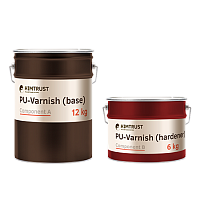
Base (Component A): a mixture of targeted additives in a hydroxyl-containing acrylic resin.
Hardener (Component B): aliphatic isocyanate.
After drying, the varnish forms a transparent, glossy coating that is resistant to UV radiation, atmospheric conditions, and negative temperatures.
Physical and mechanical parameters
Table 1 — Technical Characteristics of the Liquid Material
|
Characteristics
|
Value
|
Recommended Component Ratios:
Component A, parts by weight
Component B, parts by weight
|
100
23
|
|
Viability at (20 ± 2)ºC, hours, not less than
|
3
|
|
Conditional Viscosity by Viscometer VZ-246 (nozzle 4 mm) at (20±2)ºC, seconds, not less than
|
20
|
Non-volatile content, %, not less than
— by volume, %, not less than
— by weight, %, not less than
|
45
52
|
|
Consumption for a single-layer coating of 30-40 µm, kg/m2
|
0.08–0.12
|
Table 2 — Coating Technical Specifications
|
Property
|
Value
|
|
Appearance
|
Smooth, glossy, transparent surface
|
|
Coating gloss by photoelectric gloss meter, %, not less than
|
80
|
Drying time of the coating to degree 3, h, not more than
1st layer
2nd and subsequent layers
|
3
6
|
Final strength gain, at a temperature of (20±2)°C, days, not less than
— pedestrian load
— mechanical loads
— chemical loads
|
2
7
30
|
Coating resistance to static exposure to liquids, h, not less than
— water
— 3% NaCl solution
— 25 % sulfuric acid solution
— 5 % hydrochloric acid solution
— 3 % food-grade lactic acid solution
— 30 % KOH solution
— transformer oil
|
720
720
48
720
720
160
720
|
|
Thermal resistance at 140°C, h, not less than
|
24
|
Hygienic Characteristics
The cured coating does not have a negative impact on human health and the environment.
Component A — when in contact with the skin and eyes, may cause irritation and allergic reactions.
Component B — when in contact with the skin and eyes, may cause irritation and upper respiratory tract irritation.
Preparing for work
Surface Preparation Requirements
Clean the surface from old coatings, dirt, dust, and other contaminants using a sandblasting machine, grinding machine, or sandpaper.
Remove any dust that has formed, degrease with a solvent (acetone, toluene, butyl acetate, R-646, R-4, R-5).
Prime the surface with a solution of varnish and xylene (1:1). After the primer layer has dried, sand the surface with fine-grit sandpaper (P280—P400 according to GOST R 52381), and then remove dust from the surface using a dry cloth. If large-pored wood species are being lacquered, apply at least 2 coats of primer.
The moisture content of the wooden surface should not exceed 8%, and measurements should be taken with a moisture meter of the MG4DM type.
Product Preparation Requirements
Before starting the work:
- Ensure that the temperature of the components is between +15°C and +20°C.
- Mix Component A until a uniform mass is formed for 2 minutes using a mixer with a spiral attachment (such as ZUBR MR-1400-21 or similar) at a speed of 300-400 rpm.
- Add Component B to Component A in the recommended ratio. Mix the components for 2-3 minutes until a uniform mass is formed. Close the container and let it stand for 20 minutes to remove air bubbles from the mixture.
Requirements for Conditions of Use
- Air temperature from +5°C to +35°C.
- The temperature of the substrate should be 3°C above the dew point.
- Relative humidity of the air should not exceed 80%.
Security measures
Do not work near open flames.
When working with the varnish in enclosed spaces, ensure ventilation and have fire extinguishing equipment on hand.
Use personal protective equipment: special clothing, gloves, safety shoes, protective goggles, and a respirator.
In case of skin contact, remove the product with a cotton ball or cloth, then wash the skin with warm soapy water. In case of eye contact, rinse with a large amount of water.
If irritation occurs, seek medical attention.
Processing/Application Guidelines
Apply the varnish using the following methods:
- Airless spraying (using a paint gun like HYVEST 7300)
- Pneumatic spraying (using a paint gun like FUBAG BASIC S1000/1.8 HP)
- Manually with a brush or roller
Apply the varnish in layers, taking into account the waiting time between layers (Table 4). Before applying the next layer, the previous one should be sanded.
3–4 days after applying the last layer, it is possible to polish the surface with a felt wheel or a sanding machine with coarse fabric attached.
During application and for 12 hours afterward, ensure there are no drafts.
Table 3. Recommended Application Parameters
|
Indicator
|
Recommendations*
|
|
Recommended Thinner
|
Xylene, toluene
|
|
Airless Spraying
|
|
hinner Amount, %, not more than
|
5
|
|
Operating Pressure, MPa (bar)
|
12–16 (120–160)
|
|
Nozzle Diameter, inches (mm)
|
0.009–0.011 (0.23–0.28)
|
|
Pneumatic Spraying
|
|
Thinner Amount, %, not more than
|
5
|
|
Operating Pressure, MPa (bar)
|
0.2–0.4 (2–4)
|
|
Nozzle Diameter, inches (mm)
|
0.047–0.071 (1.2–1.8)
|
|
* The specified parameters are recommended and may vary depending on the capabilities of the equipment used, construction configurations, and temperature conditions.
|
Table 4. Dependence of Drying Time on Temperature
|
Conditions
|
Temperature During Application, °C
|
|
+5
|
+15
|
+25
|
+35
|
|
Interlayer Exposure Time, hours
|
10
|
6
|
2
|
1.5
|
|
Finish Layer Drying Time, hours
|
12
|
8
|
4
|
2
|
Problems and Their Solutions
Problem: The base of the lacquer (component A) stratifies during prolonged storage.
Solution: Mix component A until a homogeneous mass is formed for 5 minutes using a mixer with a spiral attachment (ZUBR MR-1400-21 or a similar one) at a speed of 300–450 rpm.
Problem: Poor flame spread during spraying due to high viscosity.
Solution: Heat the lacquer to a temperature of +15°C to +30°C, keeping it for a day in a heated room, or dilute it with xylene/toluene (Table 3). If flame spread is still insufficient after dilution, adjust the operating pressure of the apparatus or the nozzle diameter.
Transportation and Storage Conditions
Store them in enclosed warehouse facilities in the original sealed packaging under conditions that prevent moisture and direct sunlight exposure.
The components of the lacquer should be transported by all means of transportation in closed transport vehicles in accordance with cargo transportation rules that ensure the integrity of the packaging without damage or leakage.
Storage temperature: from 0°C to +25°C.
Shelf life when these conditions are met: 6 months from the manufacturing date.