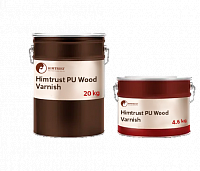
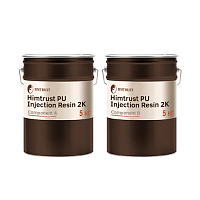
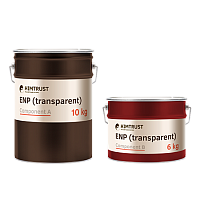
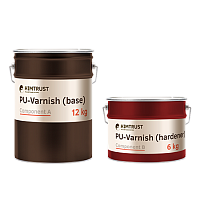
Product description
Two-component system.
Component A is a suspension of polyesters, functional additives and fillers of any color at a client’s choice.
Component B is a liquid of a dark-brown color.
Physical and mechanical parameters
|
Parameter
|
Value
|
|
Abradability
|
100–110 mg / 1000 rpm
|
|
Apparent Brookfield viscosity at 25 °C
|
KA-6000-8000 KB(hardener) — 150–250 MPa×s
|
|
Dry residue
|
100 %
|
|
Surface film formation time
|
6 hours
|
|
Adhesion to metal
|
4–5 MPa
|
|
Shore A hardness
|
97–98 standard units
|
|
Прочность на разрыв
|
16–17 МПа
|
|
Elongation at break
|
12 %
|
Usage Preparation
The base of the application surface must meet the SNiP 3.04.01-87 requirements:
- concrete grade should not be lower than M300;
- compressive strength for transport-loaded surfaces should be 25 MPa (250 kg/cm2);
- compressive strength for pedestrian surfaces should be 17.5 MPa (175 kg/cm2);
- humidity should be no more than 4 %;
- poured concrete surface should take at least 28 days to fully dry.
Surface preparation
- Clean the base from debris, dust, dirt and other organic substances.
- Align with a sander with an abrasive diamond disc.
- Remove any dust left with a vacuum cleaner.
- Clean cracks and micro-cracks from dust and dirt.
- Fill the cracks with a mixture of Himtrust Primer-NP (2K) and quartz sand 0.1–0.3 mm in a ratio of 1:7 by weight.
- After 24 hours, treat the surface with a sandpaper or sanding machine.
- Remove any dust left after sanding with a vacuum cleaner.
- Apply Himtrust Primer-NP (2K) with a thickness of 0.2–0.3 mm
- After 10 minutes of primer application, cover the surface with an excess 1.5 kg/m2 of dry quartz sand.
- After 24 hours, remove the remaining sand with a broom or industrial vacuum cleaner.
- In case of any craters, clean the surface with a sandpaper or a sander.
Attention! Do not wash the surface with water.
Application
- Mix component A in a low-speed (no more than 200 rpm) mixer (drill with mixing nozzle) for 5 minutes.
- Pour the bucket with the component B into the bucket with the component A. In a partial application use the ratio A:B 100:20 by weight.
- Stir for 2 minutes until liquid becomes homogeneous. Settle for one minute and mix again for another minute. Make sure to mix at the bottom and on the walls of the bucket.
- Let it settle for 2 minutes after mixing to release the entrained air.
The mixture settling time in the bucket should be:
— no more than 15 min at 10 °C
— no more than 10 min at 20 °C
— no more than 5 min at 25 °C.
- Pour the mixture on the prepared surface making puddles or stripes.
- Evenly distribute the mixture with a rubber scraper, spatula or squeegee on a surface with 1–2 mm thickness. Use specialized wet-step sandals (Aero-sandals) to move on the surface of the self-leveling floor.
- After 10 minutes, roll the surface with a needle roller to remove residual air.
- To avoid visible boundaries when joining two sets of material in one layer of the self-leveling floor, it is necessary to fill in the second set no later than 15 minutes after the previous layer.
- After completing work, rinse the tools with toluene, xylene or solvent 646.
- fter coating, it is necessary to isolate the room, blocking access to drafts, polluted air and insects. Drying time at a temperature of 20 °C of each layer — 24 hours; pedestrian loads are possible after 48 hours; full operation (installation of equipment, heavy furniture) after 120 hours.
Health effects and precautions
Follow and observe safety regulations in accordance with SNiP III-4-80. Use personal protective equipment: a gas mask or protective mask, special clothing including gloves and shoes, covering all parts of the body.
Storage recommendations
Shelf life is 6 months from the date of manufacture at 20 °C and without opening the container.
Problem Solution
Problem
Presence of bubbles, cavities, untreated or brittle areas on the surface, and ingress of dirt particles during the filling.
Solution
- Remove the defected area with a sander.
- Clean the base.
- Re-apply the layer of material Himtrust NP (solid).
- After removing the defects on the surface, the boundary between the old and freshly removed layer will be visible. To remove this boundary, polish the entire surface of self-leveling floor and apply a polyurethane matte varnish with a gloss level of more than 10 %, such as Huntsman Finishlak 106 with 0.2 mm thickness.