
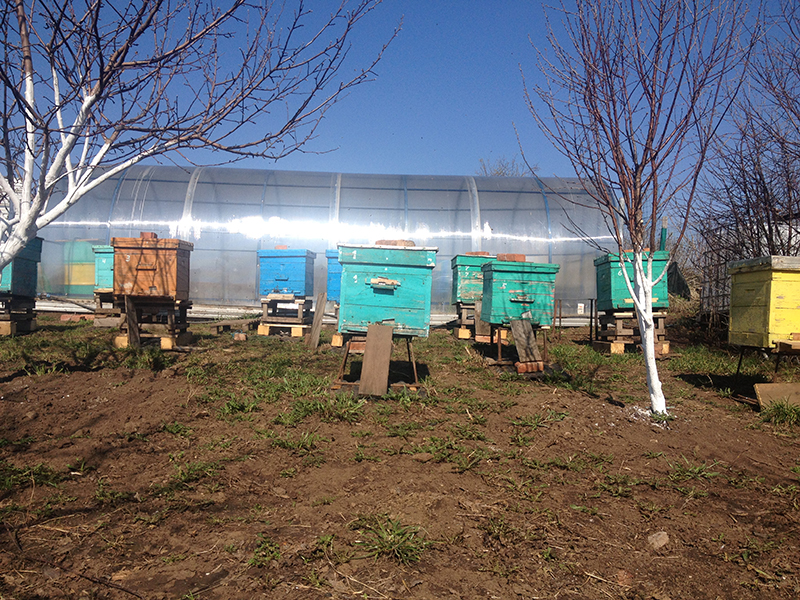
As soon as the last snow melted, my father called me to the village side to take out the hives which have been wintering in the basement. In the basement, I’ve noticed that five bee families did not survive the winter, making their homes look like a mess. My father explained that due to the abrupt weather changes, life of the bee families was cut short. Since Himtrust is manufacturing components for the thermal insulation, I have developed an idea to apply the present chemical knowledge to solve the problem. How do I select an appropriate material?
In this article, I will discuss some issues of using polyurethane foam (hereinafter PU) in the hive production:
Does PU affect the honey quality?
What are the advantages and disadvantages of using PU?
What is better for bees: PU or PPS?
Polyurethane foam has been known since the 60s. It is obtained by mixing two components of polyol and polyisocyanate. Each of them, individually, is harmful to the human body. However, after mixing them to a new substance-polyurethane, it becomes safe for health. Here is another example from life: sodium in its pure form is an extremely dangerous material, and chlorine is a toxic gas, if enters the lungs, causes them to burn and leads to death from suffocation. Mixing these two deadly substances, sodium and chlorine, gives us an irreplaceable daily product - table salt. It is the same concept with polyurethane. To go deeper, polyurethane has long been used in medicine. Thus, studies of polymer reactions in the human body for plastic purposes have shown the applicability and harmlessness of polyurethane materials. The use of PU for warming hives does not affect the quality of the honey and life of the bees.
All Himtrust’s components are certified by the sanitary and epidemiological regulatory authorities, confirming their safety to the living organisms.

The advantages of using polyurethane foam for hives
- Retain heat: the thermal conductivity coefficient of PU is 0.024 W•m * °C . For example, a Linden tree, which bees often use to make their hives, has a six times higher rate ( 0.15 W•m * °C)
- Bees have better wintering season: it was established that bee families wintering in PU haves evolve better, eat less, thus they spend less energy;
- Noise insulation;
- It is not exposed to rotting, expansion, drying and moisture
- Rats and mice do not chew PU;
- Easy to wash, dry and disinfect;
- Since PU components for hives are cast on molds, the dimensions are maintained the same, making it easy to assembly and disassembly parts together without pre-fitting.
- Light weight: assembled three-level hives weigh only 15 kg, wooden ones are twice heavier;
- Environmental friendliness of the material;
- Strength: making a hive with a density of 100 kg / m3, you get a solid structure that will last at least 25 years;
- Mobility: at a minimum cost of time and money, hives could be built at apiary, at home and in the forest.
Disadvantages of PU hives
- PU is inherently sensitive to the sunlight. This problem, however, is easily solved by painting. You can choose a water-based paint, alkyd, nitroemal, etc. German professor Karl Frisch, after studying bees color vision, found out that they perceive only white, yellow and blue colors;
- Usage of metallized coatings such as silver or aluminum foil is also helpful for bees, as they shield the earth's electric field;
- Vapor permeability will force developers to take care of additional ventilation of hives;
What is better for bees, PU or PPS?
PU and PPS (Styrofoam) have long been discussed among manufacturers of the thermal insulation. Having conducted a comparative analysis of materials for building hives, I believe PU is better than PPS due to the following:
- PPS has low physical and mechanical parameters ;
- It exposed to chemical compounds;
- The decomposition temperature of PPS is lower (60 °C) than of PU (130 °C);
- Humidity of the material is the cause of mold and mildew inside the hive;
- The danger of PPS is in its chemical structure. This polymer is subject to depolymerization with the release of a residual highly toxic substance styrene. It affects the heart, liver, and mucous membranes even in small amounts.
After measuring pros and cons, I advised my father to buy or make the hives from PU. I am sure that this decision will benefit both, my father and the bees.
Himtrust produces SKD-50 system. The system Himtrust SKD-50 is used for the production of bee hives with a density of
80-120 kg/m3 in the finished product.